
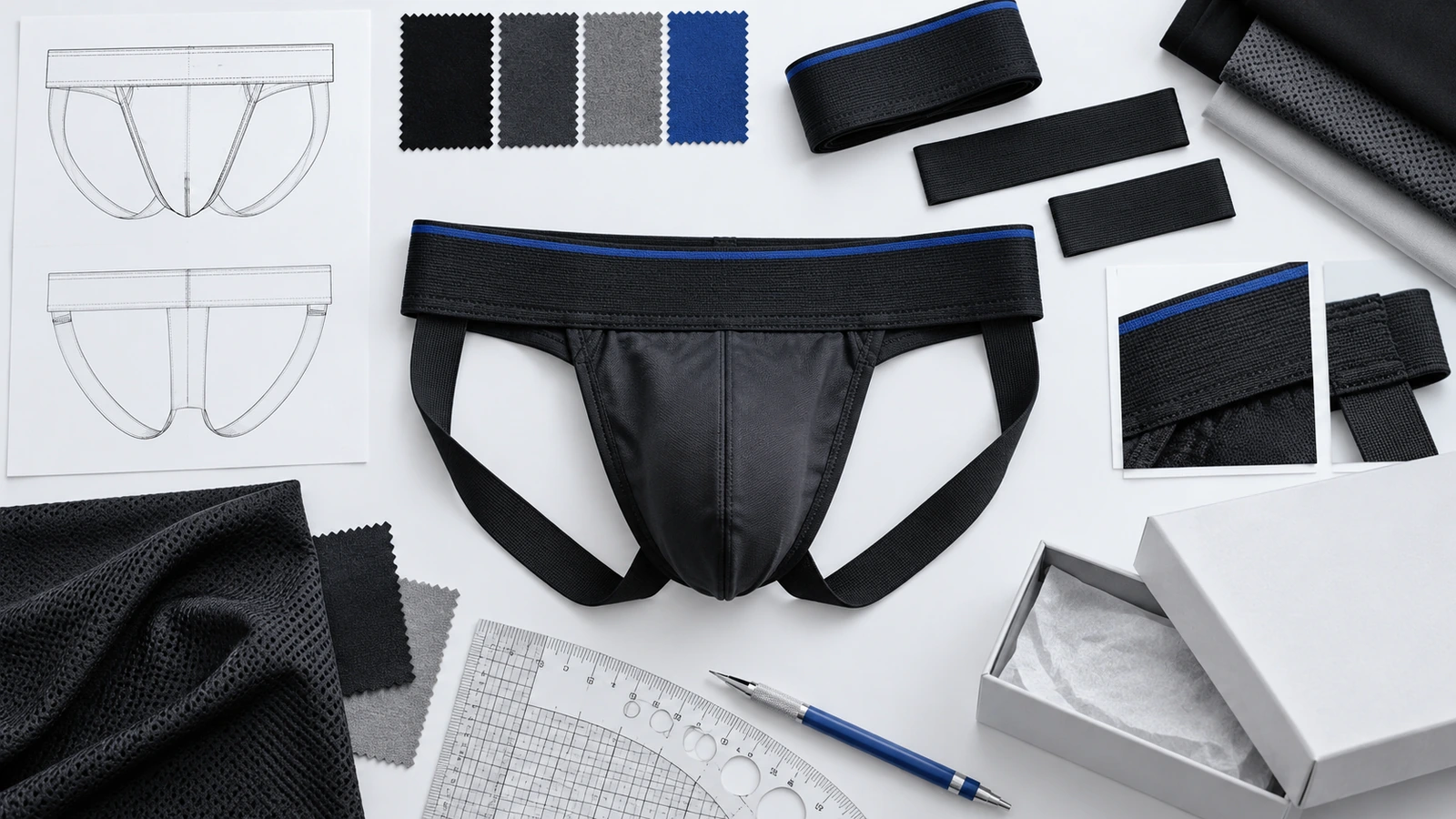
A successful private label jockstrap development project starts with a clear wearer, use case, and product brief—not with a logo placed on a generic sample. A brand needs to define how the pouch, waistband, rear straps, fabric, seams, sizing, and branding should work together. Those decisions then need to be tested through prototypes and documented before production.
This guide explains how a brand buyer can turn an aesthetic idea into reviewable product variables. It is intended for underwear, queer-fashion, clubwear, performance, and men’s intimate-apparel brands. Exact measurements, elastic requirements, sewing settings, testing methods, and production feasibility depend on the design and should be agreed with the supplier during development.
Key Takeaways
- Define the target wearer and use scenario before selecting materials or branding.
- Treat the pouch, waistband, rear straps, fabric, seams, and attachment points as one product system.
- Separate body measurements, garment measurements, fit variables, and grading rules.
- Approve the actual fabric and elastic through samples rather than relying on generic specifications.
- Record prototype comments and confirm the final construction before production handoff.
1. Define the Collection Before You Define the Product
The word “jockstrap” does not describe one universal product. An athletic-support style, a fashion-led intimate style, and a body-enhancing clubwear style may share an open-back silhouette, but their design priorities can be very different.
Identify the primary wearer and market
Start by identifying the primary customer, target market, intended size range, price position, and sales channel. A specialist queer-fashion brand may prioritize expressive proportions, bold branding, and a sexier silhouette. A performance-oriented line may place more emphasis on stability during movement. A broader lifestyle collection may need a balance of comfort, visual appeal, and everyday wearability.
These examples should not become stereotypes. LGBTQ+ and queer customers do not share one body type, style preference, or use case. The practical goal is to define the audience for this particular collection and translate that positioning into product decisions that can be sampled and reviewed.
Choose the use scenario
Write down the intended use before discussing the fabric:
- Athletic or support-oriented: movement, stability, skin contact, and attachment security may receive more attention.
- Fashion or intimate apparel: hand feel, line, coverage, color, and visual proportion may lead the brief.
- Clubwear or performance: the garment may need to balance movement, stage visibility, styling, and body emphasis.
- Hybrid use: the brand should decide which requirements take priority when appearance and support goals conflict.
Words such as “supportive,” “sexy,” or “body-enhancing” are not complete specifications. They need to be translated into pouch projection, coverage, rise, strap position, waistband behavior, material choice, and fit-review criteria.
Set the assortment logic
Decide whether the collection contains one core construction in several colors or several genuinely different silhouettes. Changing a waistband logo or color does not necessarily create a new fit. Changing pouch geometry, rear-strap placement, or rise usually affects the pattern and should be treated as a structural variation.
Stabilizing one construction before multiplying styles can reduce unclear feedback and repeated sampling. It also helps the buyer distinguish assortment decisions from product-development decisions.
2. Translate the Concept Into Product Decisions
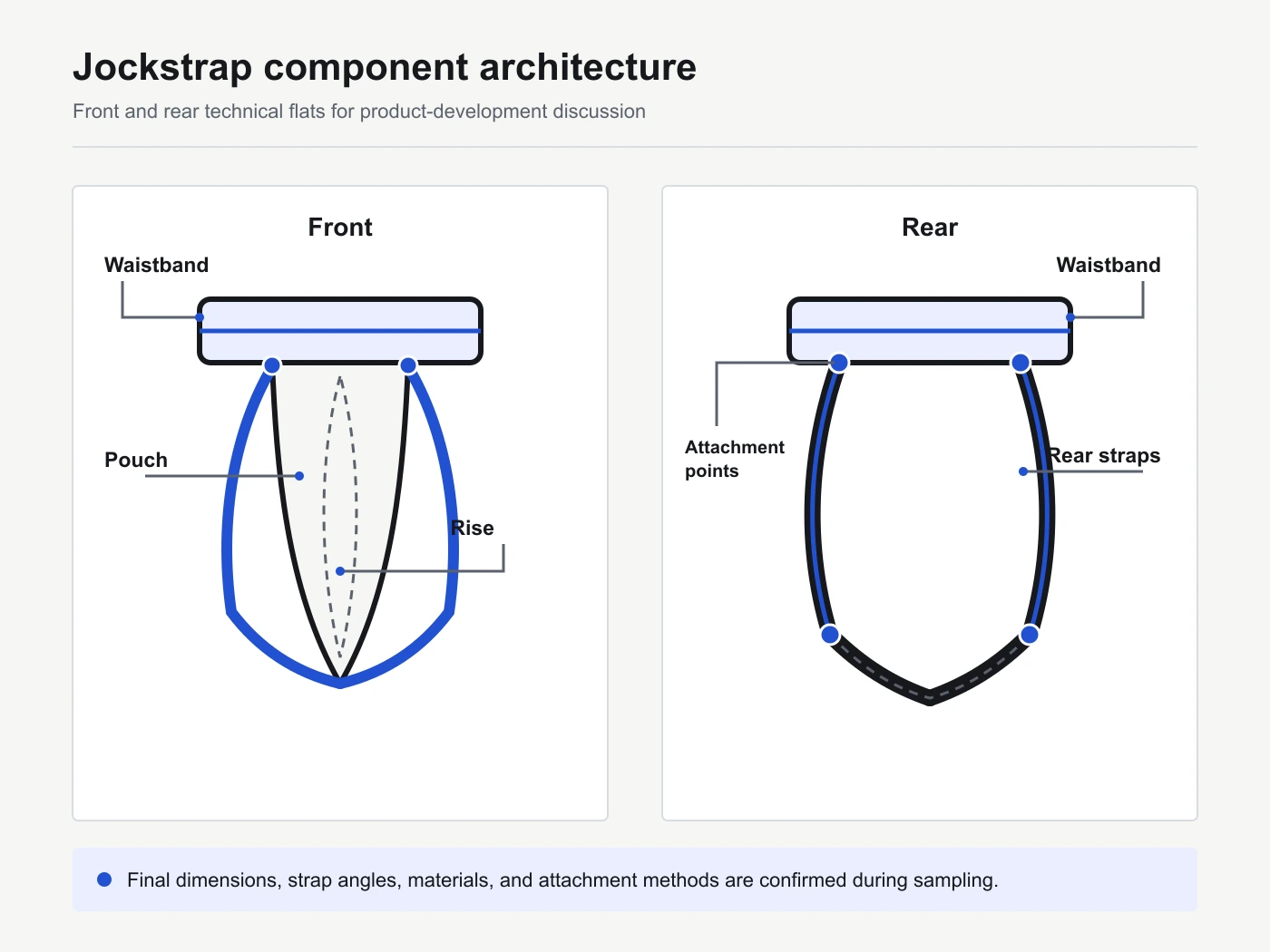
Pouch shape, coverage, support, and projection
The pouch is both a visual and functional component. A useful brief should describe the intended coverage, projection, seam direction, front profile, lining preference, and relationship to the waistband and rear straps. Reference images can communicate a visual direction, but they should be accompanied by written comments explaining what the brand wants to keep or change.
Avoid treating one pouch dimension as a universal answer. The result depends on the pattern, material stretch and recovery, seam construction, target wearer, and intended look. During fitting, reviewers should check whether the pouch twists, collapses, creates unwanted pressure, shifts during movement, or produces a profile that conflicts with the design intent.
Waistband specification
A waistband affects fit, appearance, branding, and the way forces from other components are distributed. The brief should address width direction, hand feel, stretch and recovery expectations, logo method, color, inside finish, and attachment to the pouch and rear straps.
Nominal width alone does not describe performance. Two elastics of the same width may behave differently. The actual elastic should be evaluated in the sample because material construction, tension, attachment, and intended use all influence the result.
Rear-strap geometry and connection points
Rear straps should be reviewed as structural and visual elements. Their width, angle, position, length, and connection points can affect pressure, movement, pouch position, and the overall silhouette.
A flat sketch may show the general shape but not how the garment behaves on a body. Sample review should therefore consider whether the straps dig in, slip, twist, pull the pouch out of position, distort the waistband, or create inconsistent left-to-right balance. The pouch-to-strap and strap-to-waistband junctions deserve specific attention because they connect components with different directions of stretch and load.
Rise and overall proportion
Rise changes the relationship among the waistband, pouch, hips, and rear straps. It also affects whether the product reads as athletic, minimal, retro, fashion-led, or body-enhancing. The brand should define the intended visual position and then confirm it on the relevant wearer profile.
General body measurements can support communication, but they do not automatically determine pouch volume or rear-strap geometry. Those are product-specific pattern and fit decisions.
3. Build a Development Brief With a Decision Table
Use a decision table to separate what the brand should define from what must be confirmed through development.
| Decision area | What the brand should define | What should be tested or confirmed | Common risk |
|---|---|---|---|
| Target wearer and use | Market, use scenario, coverage, support and aesthetic goals | Fit relevance with intended wearers | A product that looks right but serves the wrong use case |
| Pouch | Shape, coverage, projection, seam direction and lining | Fit, deformation, pressure, movement and visual profile | Excess volume, compression, twisting or instability |
| Waistband | Width direction, feel, branding, color and recovery requirement | Actual elastic behavior in the garment | Rolling, puckering, pressure or weak recovery |
| Rear straps | Width, angle, position, appearance and attachment | Movement, pressure, shifting and junction stability | Digging, slipping, distortion or attachment failure |
| Fabric | Composition direction, hand feel, weight direction, stretch, recovery and opacity | Actual material and sample behavior, including care conditions where relevant | Poor recovery, unwanted transparency or harsh skin contact |
| Seams and attachments | Location, function, appearance and comfort target | Extension, softness, visible damage, opening or slippage as applicable | Puckering, seam opening, needle damage or discomfort |
| Size and grading | Target market, body-measurement basis, finished measurements and size logic | Fit and proportion across selected sizes | Inconsistent proportions or one-size assumptions |
| Branding and packaging | Artwork, waistband logo, labels, hang tags and pack format | Placement, compatibility and approval samples | Distorted branding, poor legibility or inconsistent presentation |
The table deliberately avoids universal numbers. Acceptance criteria should reflect the actual material, construction, use case, test method, and agreed product requirement.
4. Select Fabric, Elastic, and Seams as a System
Fabric and elastic must work together
Stretch percentage is not enough to select a material. Recovery, thickness, knit structure, softness, opacity, surface texture, and care conditions may all affect the product. A fabric that suits the pouch may not perform the same function as an elastic waistband or rear strap.
The waistband and rear straps may also require separate evaluation. They contact different parts of the body and may carry different loads. The product brief should identify the required behavior, while the actual material specification should be confirmed during sampling and, where necessary, through an agreed test method.
ISO 20932-3 addresses elasticity and related properties of narrow fabrics and distinguishes quality-assurance and in-use performance purposes in its public summary. That makes it a relevant reference point when discussing narrow elastic components. It does not prove that a particular product has been tested or that SensualForm complies with the standard. Any standard-based claim would require an applicable method, documented results, and defined acceptance criteria.
Match seams and attachments to location and function
A jockstrap can include pouch assembly seams, elastic attachment, edge finishing, rear-strap junctions, and reinforcement operations. These locations do not necessarily have the same requirement. A seam near the skin may need to balance extension, softness, strength, and bulk, while an attachment point may need additional review for distortion or opening.
Coats’ seam guidance explains that seam construction, stitch type, application, and quality measures are related but distinct. It is useful supplier guidance, not a SensualForm factory specification or a universal standard. Final thread, needle, stitch, and density choices should be confirmed using the actual material, construction, equipment, and sample.
Check close-to-skin materials for sewing damage
Knitted and stretch materials can be affected by needle penetration and sewing conditions. Sample review should include visible holes, runs, puckering, seam opening, harshness, and loss of stretch near the seam. This is a quality question, not a reason to prescribe one needle or stitch setting for every fabric.
5. Separate Sizing, Grading, and Fit Variables
Private label jockstrap development becomes clearer when four types of information are kept separate.
- Body measurements describe the target wearer or population using consistent anatomical references.
- Finished-garment measurements describe the physical dimensions of the sample or approved product.
- Fit variables include pouch geometry, rise, strap placement, elastic behavior, and the relationship among components.
- Grading rules explain how dimensions and proportions change across sizes.
ISO 8559-1 provides an anthropometric framework for clothing-related body measurements and size-and-shape profiles. Its public information does not provide a ready-made men’s underwear size chart, nor does it prescribe jockstrap pouch dimensions. A brand still needs target-market data, product-specific pattern development, fit trials, and documented grading decisions.
Build a fit-review plan
Define the sample size, intended size range, wearer profile, and review conditions before fitting. Assess front, side, and rear balance. Check static appearance and movement relevant to the intended use. Record whether feedback relates to body fit, garment measurements, component geometry, material behavior, or grading.
Do not approve the base size and assume every other size will behave identically. Component proportions and strap placement should be reviewed across relevant sizes, especially when the collection covers a broad range.
6. Use a Staged Jockstrap Sampling Process
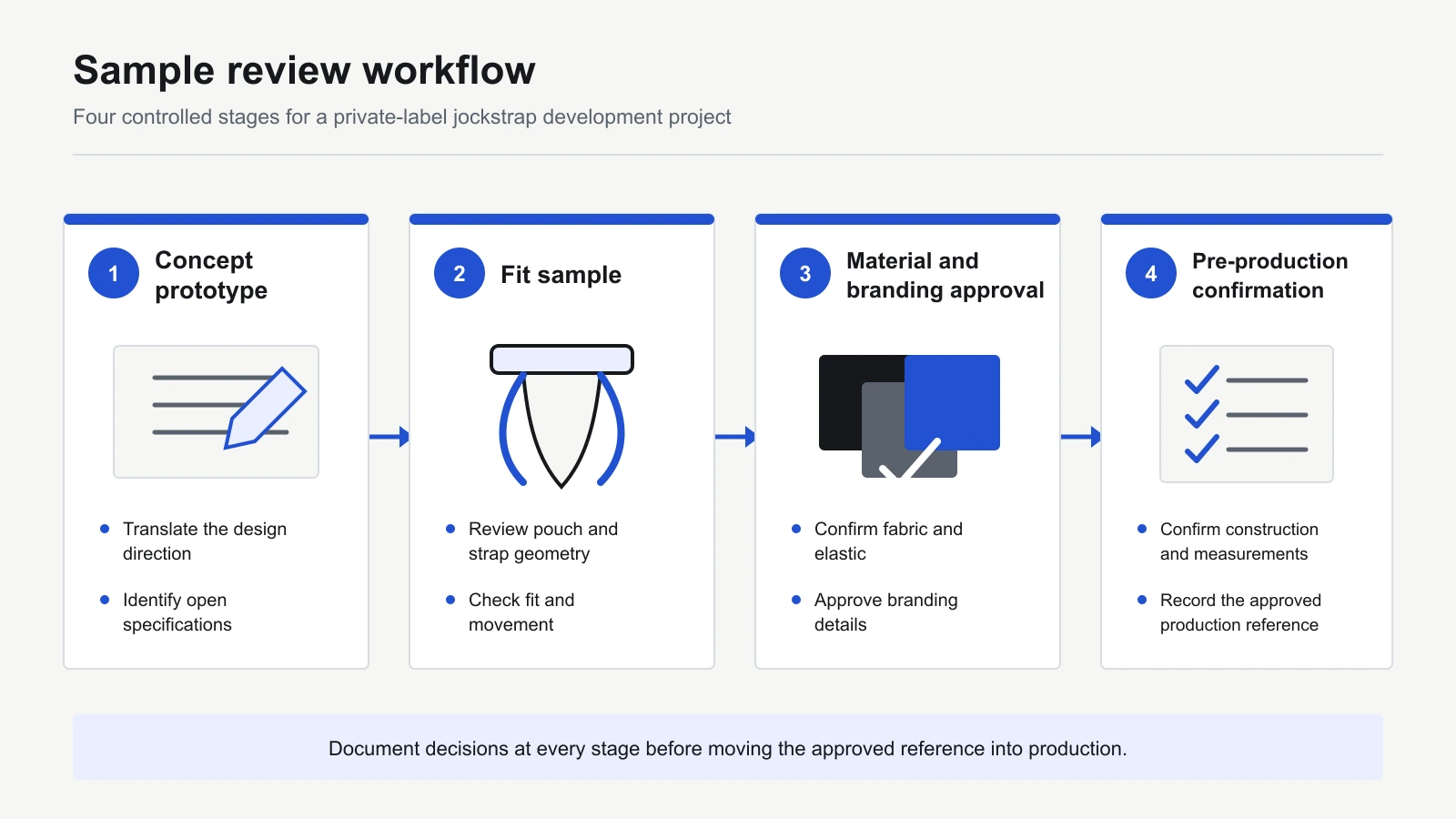
Sampling should reduce uncertainty in a controlled order. A practical process may include a concept or prototype review, a fit sample, a sample using the intended materials and branding, and a pre-production confirmation. The exact sequence depends on the project.
Sample-development checklist
- ☐ Confirm the target wearer, use scenario, market, size range, and collection structure.
- ☐ Provide reference images, a sketch, tech pack, existing product, or physical reference where available.
- ☐ Define pouch, rise, waistband, rear straps, materials, seams, branding, labels, and packaging.
- ☐ Identify which specifications are fixed and which may be proposed during development.
- ☐ Review the first prototype for proportion, coverage, basic fit, pressure, and stability.
- ☐ Check pouch deformation, waistband puckering, strap shifting, and connection behavior.
- ☐ Review seam comfort, extension, appearance, and visible material damage.
- ☐ Confirm the actual fabric, elastic, colors, branding, and packaging in the appropriate approval sample.
- ☐ Review grading and the relevant ends of the intended size range.
- ☐ Record measurement, construction, and approval comments for each sample round.
- ☐ Confirm the pre-production specification before bulk handoff.
- ☐ Keep any test method, result, and acceptance criterion traceable.
Prototype review
The first prototype should answer structural questions. Does the concept translate into the intended silhouette? Are pouch depth, rise, strap position, and waistband proportion moving in the right direction? At this stage, feedback should be specific enough to guide a pattern or construction change.
Fit-sample review
The fit sample should be assessed against the intended wearer and use scenario. Record pressure, stability, movement, coverage, visual balance, and component interaction. Comments such as “make it more supportive” should be converted into an observable issue: for example, pouch movement, strap position, elastic behavior, or a pattern-shape concern.
Pre-production review
Before bulk handoff, confirm the approved construction, measurements, materials, elastic, colors, branding, labels, workmanship expectations, packaging, and reference sample. Any test or compliance requirement should be named with its method, scope, evidence, and acceptance criteria. Production should not rely on an informal assumption that was never added to the approved specification.
7. Manufacturing and QC Considerations
Quality review should cover materials, construction, measurements, symmetry, attachments, finishing, branding, labels, and packaging. For a jockstrap, high-attention zones often include pouch seams, waistband attachment, rear-strap-to-pouch junctions, and rear-strap-to-waistband junctions.
General seam guidance distinguishes visual dimensions, seam strength, and seam slippage as different considerations. Which checks are appropriate depends on the material and product requirement. A visual inspection alone may not answer a performance question, while a laboratory result does not automatically establish comfort or fit.
A patent such as US5003972A can illustrate that waistband, pouch, straps, and attachment positions may be analyzed as interacting components. A patent is not proof of best practice, comfort, performance, or freedom to operate, and it should not be used as a construction template without appropriate design and legal review.
8. Common Development Errors and Procurement Risks
Starting with branding instead of product intent
A custom waistband cannot correct an unclear fit or use case. Branding decisions should support a defined product, not substitute for one.
Treating a reference image as a complete specification
An image does not reveal all measurements, material behavior, seam decisions, internal construction, or grading logic. Use references to communicate direction, then document the required changes and acceptance criteria.
Specifying elastic by width alone
Width is visible and easy to record, but it does not describe recovery, hand feel, tension in the garment, or behavior after use and care. Actual components may require testing and sample approval.
Using vague fit comments
“Too tight,” “not sexy enough,” or “more supportive” may describe a reaction but not the cause. Link feedback to pouch shape, coverage, projection, rise, strap geometry, elastic behavior, or another observable variable.
Ignoring component junctions
The garment may fail visually or functionally where the pouch, waistband, and straps meet. Review distortion, puckering, seam opening, shifting, and symmetry at these points.
Approving one sample without controlling revisions
If comments are spread across messages without a revision record, previously approved details can be lost. Maintain a sample log showing what changed, why it changed, and which version is approved.
Assuming supplier-specific numbers are universal
MOQ, development time, production schedule, fabric minimums, test thresholds, and sewing settings vary by design and supplier. They should be confirmed for the actual project rather than copied from another manufacturer’s page.
9. What Brands Should Provide to a Supplier
A useful development request should include as much of the following as possible:
- target wearer, market, and use scenario;
- reference images, sketches, tech pack, existing product, or physical sample;
- intended number of styles and which styles differ structurally;
- pouch shape, coverage, projection, rise, waistband, and rear-strap requirements;
- fabric and elastic direction, including required visual and performance outcomes;
- size range, body-measurement basis, finished measurements, and grading expectations;
- logo artwork, waistband branding, labels, hang tags, and packaging requirements;
- target quantity by style, color, and size;
- destination market and any required labeling, testing, documentation, or compliance review;
- desired timing, presented as a request to be evaluated rather than an assumed commitment.
Brands that already have detailed specifications may follow an OEM route. Brands that need support turning a concept into a product may require more ODM development. SensualForm’s OEM and ODM apparel development page explains these routes, while its private label apparel development page covers branding, labels, waistbands, and packaging options.
10. How SensualForm Can Support Jockstrap Development
SensualForm’s confirmed product scope includes jockstraps, and its confirmed manufacturing capabilities include cut-and-sew production for styles involving custom pouch structures, waistbands, mesh, multiple materials, and strap-based construction. The company provides OEM, ODM, and Private Label services that can include product review, pattern and sample development, fit adjustment, fabric selection, branding, labels, packaging, bulk production, and quality control.
Project feasibility, materials, quantities, schedule, testing, and certification requirements should be reviewed for the specific design. These details should not be assumed from a general article.
Brands can explore the Jockstraps category and custom jockstrap development options before preparing a project brief.
Frequently Asked Questions
What information is needed to develop a private label jockstrap?
Provide the target wearer and use case, references or a tech pack, pouch and strap direction, intended materials, size range, branding, labels, packaging, quantity, and destination-market requirements. Missing details can sometimes be developed through an ODM process, but they should be resolved and documented before production.
How is a development guide different from a manufacturer page?
A development guide explains what the buyer needs to decide, specify, test, and approve. A manufacturer or category page focuses on supplier capabilities, available product directions, commercial fit, and the next step toward a quotation.
How should a brand evaluate pouch and rear-strap fit?
Evaluate the actual sample on relevant wearers and under the intended movement conditions. Review coverage, pressure, projection, stability, strap position, shifting, waistband distortion, and left-to-right balance. Record the findings by sample version instead of relying on general comments.
Should the waistband and rear straps use the same elastic specification?
Not necessarily. They have different locations and may serve different functions. The appropriate materials and requirements depend on the design and should be confirmed during sampling and any agreed testing.
Does ISO 20932-3 prove that a jockstrap meets an elastic-performance standard?
No. The standard’s existence and scope do not prove that a product was tested or passed. A compliance statement would require an applicable method, authorized standard access, documented test evidence, and defined acceptance criteria.
Can a patent be used as a jockstrap construction template?
A patent can help identify structural questions, but it is not proof of best practice or permission to copy a design. Patent status, claim scope, and freedom-to-operate questions require authoritative records and qualified legal review.
Prepare the Brief Before You Request the Sample
A strong jockstrap collection is developed by making aesthetic and functional goals reviewable. Define the wearer and use case, map the pouch-waistband-strap system, separate sizing inputs, and approve the actual materials and construction through controlled sample rounds.
If you are preparing a new collection, discuss your jockstrap collection requirements with SensualForm. Share your use scenario, references or tech pack, intended materials, size range, branding, estimated quantity, and packaging needs so the project can be reviewed without assuming feasibility, timing, or technical claims in advance.